Beyond the Transcript: How Audio Analysis Reveals What Social Video Really Means
You have probably had this experience. A creator says “great product” in the middle of a TikTok review and the caption tags it as positive. But anyone who actually watched the video can hear the half-laugh, the pause before the word, the slight downward turn at the end of the sentence. The words say one thing. The voice says another. The transcript captures the words and loses everything else.
This is the central limitation of transcript-only analysis, and it is the reason most social listening platforms are still missing the majority of what is actually being said about brands inside video content. Audio analysis is what closes that gap.
What gets lost when video becomes text
When speech is converted into a written transcript, roughly seventy per cent of the communication’s actual meaning is stripped away. Linguists have known this for decades. The human voice carries layers of information that simply vanish the moment it is reduced to written words.
Think about the last time you misread someone’s tone in a message. Now imagine making strategic brand decisions based on that same flattened information at scale, across thousands of TikTok, Instagram and YouTube videos discussing your category every week. That is what happens when social listening relies solely on captions, hashtags and machine-generated transcripts of creator content.
The video is rich. The transcript is a skeleton. Most enterprise social listening tools are working from the skeleton.
What audio analysis actually captures
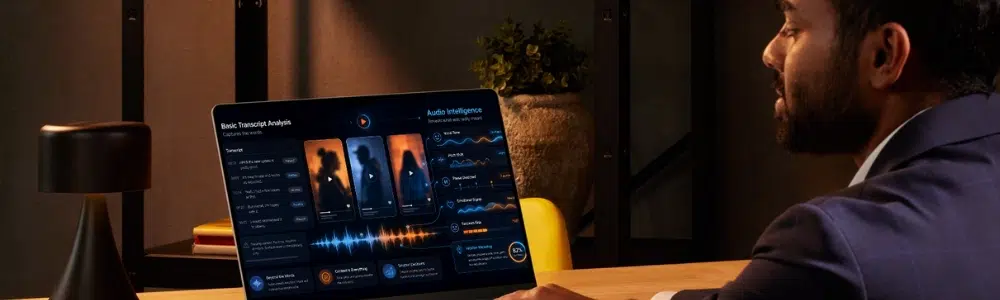
Modern audio analysis goes far beyond speech-to-text. It examines the acoustic properties of speech itself, capturing signals that text-based methods cannot detect.
Vocal prosody reveals emotional state through pitch variation, speaking rate and rhythm. When a creator’s pitch rises sharply at the end of a supposedly positive statement, that is often a flag for sarcasm or hesitation. When their delivery speeds up around a specific product feature, you are seeing cognitive load or genuine excitement in real time.
Acoustic intensity captures emphasis and energy. The difference between a flat “this is good” and one delivered with real enthusiasm is measurable in decibels and frequency distribution. Two videos with identical transcripts can carry completely different sentiment. A transcript-first tool sees them as the same. Audio analysis sees them as opposites.
Temporal patterns expose the hesitations, interruptions and pauses that signal uncertainty or discomfort. A three-second pause before “yes, I would recommend it” tells a very different story than an immediate, confident endorsement. Transcripts typically remove these pauses entirely or reduce them to ellipses, taking the meaning with them.
What this looks like inside social video
Consider an unboxing video on YouTube. The creator says “I found the interface really intuitive.” A transcript-first tool codes this as positive. Audio analysis might detect:
- A slight vocal fry suggesting disengagement
- A downward pitch pattern indicating actual uncertainty
- A pause before “intuitive” showing the creator is searching for a diplomatic word
- A faster speaking rate than the creator’s baseline, suggesting social desirability bias from a sponsored partnership
You are no longer reading a surface review. You are seeing the authentic response that will predict whether their audience actually buys the product.
The same shift applies across the social video landscape. In influencer monitoring, audio analysis can flag creators whose sponsored posts use the right brand language but deliver it with tones that audiences instinctively read as inauthentic. The script looks perfect. The audio reveals the disconnect that erodes campaign return on investment. In trend detection, the difference between a video that will go viral and one that will not is often audible in the energy and pace of the creator’s delivery, weeks before engagement metrics confirm it. In brand-adjacent content monitoring, the same product can be discussed with wildly different sentiment across thousands of videos. Transcripts give you the count. Audio gives you what the count actually means.
This is the kind of inside-video signal that traditional social listening tools cannot reach. It is the same hidden iceberg that the Iceberg Effect post described, viewed from a different angle.
The technical depth behind the signal
Advanced audio analysis platforms use machine learning models trained on vast datasets of human speech across languages, accents, recording conditions and platform-specific audio formats. These systems detect what amounts to micro-expressions in voice, the audio equivalent of fleeting facial cues that reveal genuine emotion.
They measure parameters such as jitter and shimmer in vocal quality, which correlate with stress and authenticity. They analyse formant frequencies that differ between genuine and manufactured emotion. They detect synchrony patterns across creators discussing the same product, which can indicate organic momentum versus coordinated content drops.
None of this exists in a transcript. A transcript is a rough map of what was said. Audio analysis is a recording of what was meant.
Combining audio with text, not replacing it
Moving beyond transcript-only social listening does not mean abandoning text analysis. The strongest approach combines both. Text remains excellent for keyword extraction, topic modelling, hashtag tracking and the structured signals around video content. Audio analysis provides what only it can: the emotional truth of what is being said inside the content.
The brands and platforms already making this shift are seeing measurably better outcomes. More accurate sentiment classification. Earlier identification of brand risk inside influencer content. Deeper understanding of what actually drives purchase intent inside creator reviews, rather than what audiences politely click on afterwards.
The acoustic science is settled. The competitive question is whether your current social listening setup is reaching the audio layer at all, or working from transcripts and hoping the transcripts tell the truth.
What this means for your category
Every category has its own audio signature. Beauty creators speak differently to gaming creators. Tech reviewers carry different cadences to fitness influencers. The vocabulary moves, the tone moves, and the signals worth listening for move with them. A social listening setup that ignores audio is operating on the same data its competitors had three years ago. A setup that captures audio at scale is reading the next twelve months of consumer language before it surfaces in captions.
The brands seeing the biggest wins are the ones with the most complete picture. The ones who can hear, not just read, what is being said about them on screen, in voice and in context, and act on that understanding before it hardens into headlines.
Hear what your transcripts are missing
If your social listening programme is working off captions and machine transcripts, you are extracting somewhere between five and thirty per cent of the available signal. The other seventy per cent is sitting inside the audio of the videos your category lives in, untouched.
Social Voice analyses voice, visuals and context inside social video at enterprise scale and feeds that intelligence into the platforms your team already uses. No rip and replace. No new dashboard for your team to learn. Just the layer of meaning that has been missing from social listening since video took over.
If you would like to see what audio analysis could surface inside your category specifically, we would be happy to show you. Book a short demo and we will walk through the videos your current tools are processing as text and what they actually contain.