The Technical Evolution: How AI and Speech Recognition Are Finally Making Video Social Listening Scalable
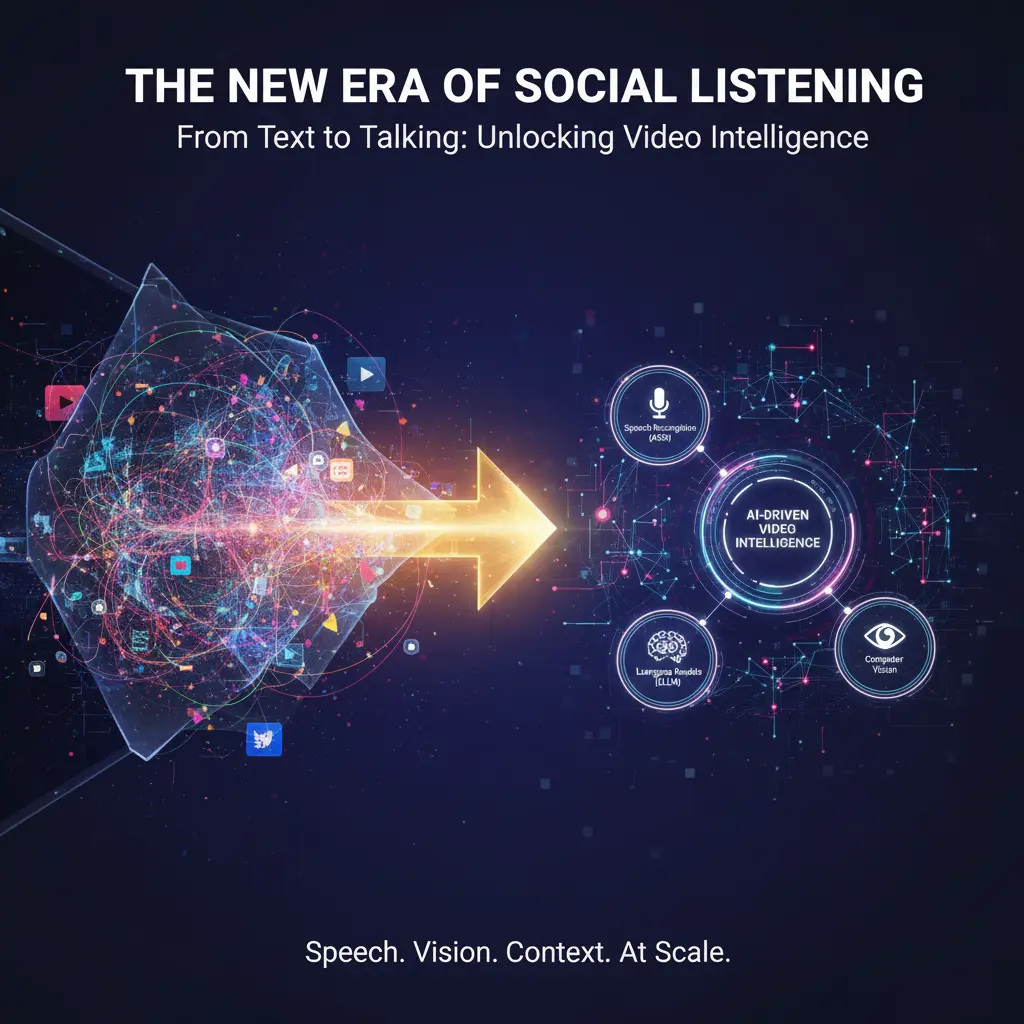
From Text to Talking: The New Era of Social Listening
For years, social listening lived in a text-only world. Brands could track mentions, analyse sentiment, and measure buzz across tweets, posts, and comments — but video remained a black box.
It wasn’t that marketers didn’t want to analyse what people were saying in videos — they simply couldn’t. The content was trapped behind layers of unstructured data: voice, visuals, and motion. The cost and complexity of analysing millions of videos made it nearly impossible.
Until now.
Recent breakthroughs in AI, speech recognition, and computer vision have changed everything. What was once a technical wall is now a scalable system — finally making video social listening both possible and practical.
See how Social Voice helps brands capture intelligence from inside video →
The Speech Recognition Breakthrough
Automatic Speech Recognition (ASR) isn’t new — you use it every time you talk to Siri or dictate a message. But enterprise-grade ASR for social content? That’s a different story.
The challenge was always real-world chaos: background noise, overlapping voices, regional accents, slang, and the low-quality audio of smartphone clips.
That’s where transformer-based models like OpenAI’s Whisper and Google’s USM changed the game. Trained on millions of hours of diverse speech, they can now handle:
-
Accented and informal language.
-
Background noise and ambient sound.
-
Overlapping dialogue and mixed speakers.
Accuracy rates above 95% mean that spoken data is now analysable at scale — the point where video finally becomes measurable, searchable, and meaningful.
Learn how Social Voice integrates advanced speech models into platform workflows →
Understanding Context: The Power of Language Models
Transcribing speech is only half the battle. Understanding it — tone, meaning, emotion — is where large language models (LLMs) come in.
Unlike older keyword-based systems, LLMs read between the lines. They interpret sarcasm, slang, and cultural nuance. They know that “this product is literally fire” in a TikTok doesn’t mean a recall risk.
This semantic understanding lets brands track:
-
Product mentions hidden inside long-form reviews.
-
Competitive comparisons without explicit tags.
-
Pain points and feature requests in casual conversation.
-
Emerging trends long before they hit captions.
It’s a leap from basic sentiment to real emotional intelligence.
See this shift in action with our Skin Care Case Study →
Seeing the Whole Picture: Computer Vision Joins the Conversation
Video listening isn’t just about what’s said — it’s about what’s shown.
Modern computer vision models can now detect products, logos, packaging, and brand presence inside video frames with remarkable precision.
If your product appears in a “What’s in my bag?” video, a grocery haul, or a creator’s kitchen — even for three seconds — these systems see it.
And when combined with voice and text analysis, you get a multi-modal understanding of context:
-
Who’s speaking.
-
What’s being said.
-
What’s visible on screen.
It’s the difference between tracking mentions and seeing your brand’s real-world footprint.
Explore our Brand Safety Case Study →
Scalability: The Final Barrier Falls
Even a few years ago, processing this much data was cost-prohibitive. One hour of video equals 86,000 frames, plus audio and metadata. Multiply that by millions of uploads, and you hit a computational wall.
Today, GPU acceleration and cloud AI infrastructure have changed the math. Services like AWS, Google Cloud, and Azure make it possible to analyse video at scale, in near real-time, for a fraction of the cost.
What used to take hours now takes minutes. What once cost thousands now costs dollars.
Scalable video social listening is no longer theoretical — it’s happening now.
Meet the team powering this innovation →
Why It Matters for Brands Right Now
Social media has already gone video-first:
-
TikTok drives trends.
-
YouTube is the world’s second-largest search engine.
-
Instagram prioritises Reels.
-
Even LinkedIn is boosting video engagement.
If your brand’s listening strategy still focuses on text, you’re missing most of the conversation.
The creators shaping sentiment? They’re speaking on camera.
The authentic reviews driving purchases? They’re filmed, not typed.
The early signals of market shifts? They appear in tone, not text.
AI-driven video analysis lets brands finally hear those signals — accurately, at scale, and in context.
Discover how Social Voice empowers Brands & Agencies to decode video insight →
What’s Next: The Future of Video Intelligence
The next generation of AI is already building on this foundation:
-
Emotion detection that identifies trust, hesitation, or delight.
-
Trend forecasting predicting which topics will go viral before they peak.
-
Cross-platform narrative tracking to follow stories as they move from TikTok to YouTube to podcasts.
-
Synthetic media detection to spot AI-generated or deepfake content.
The brands adopting video-first listening now are building the intelligence muscle that will define tomorrow’s marketing leaders.