Beyond the Transcript: How Audio Analysis Unlocks the Consumer Sentiment Traditional Tools Miss
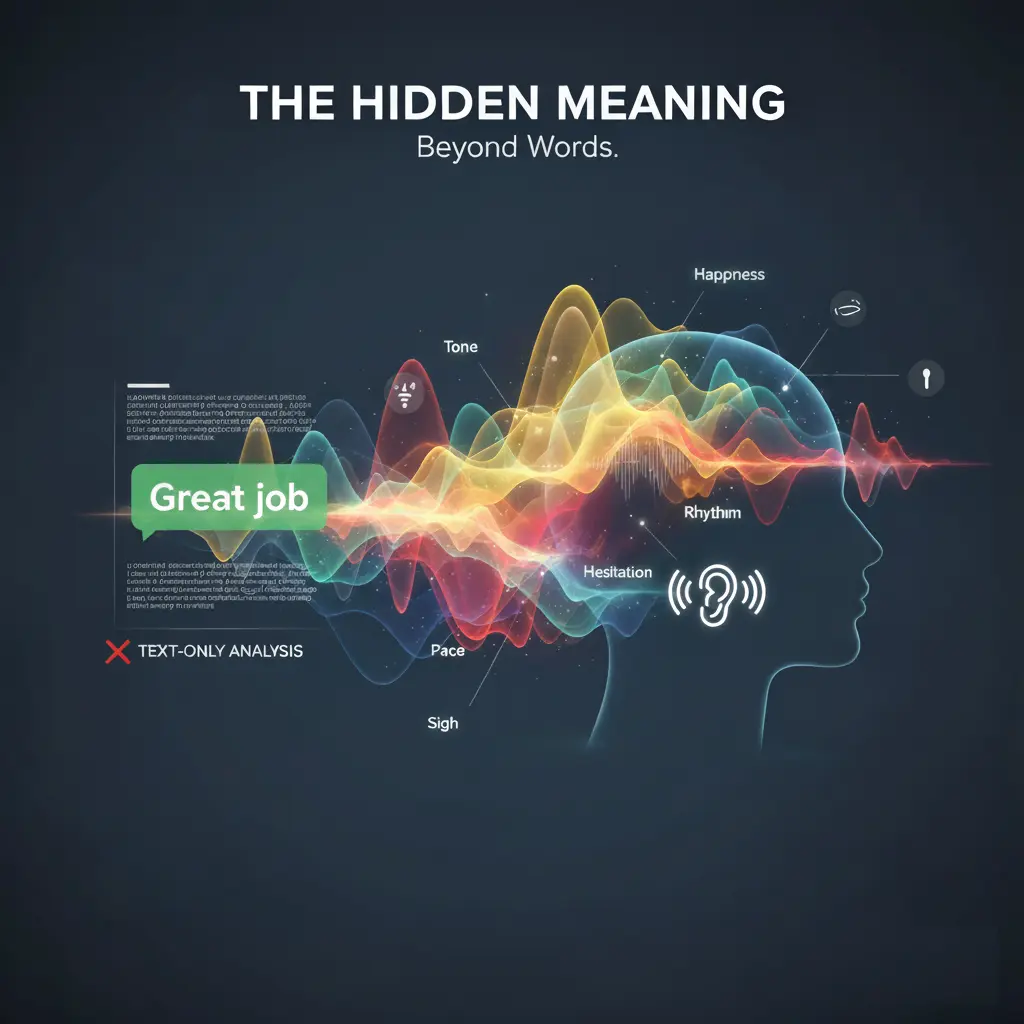
The Hidden Meaning Behind Every Word
You’ve probably seen it happen. A customer writes “Great job” in a survey, and your sentiment dashboard lights up green. But what if that same customer said it with a sigh, an eye-roll, or a tone dripping with frustration?
That’s the problem with text-only analysis — it captures words, not emotions. And in doing so, it leaves up to 70% of human meaning unheard.
Traditional transcript tools were built for what people say. But real insight lives in how they say it — in tone, pace, rhythm, and hesitation.
See how Social Voice helps brands capture emotion inside video →
The Limit of Text-Based Understanding
When speech becomes text, most of its context disappears. Linguists have known this for decades — the human voice carries layers of emotional information that vanish the moment it’s flattened into words.
Think about the last time you misread someone’s tone in an email. Now imagine building your brand strategy, your customer research, or your product roadmap on that same misunderstanding.
That’s what happens when businesses rely solely on transcripts of customer calls, focus groups, or social content.
What Audio Analysis Really Reveals
Modern audio intelligence goes far beyond speech-to-text. It doesn’t just document language — it decodes emotion.
-
Vocal prosody uncovers emotional states through pitch, rhythm, and pace. A rising pitch at the end of a “positive” statement often signals doubt.
-
Acoustic intensity reveals genuine enthusiasm or frustration — measurable differences in energy and frequency.
-
Temporal patterns expose hesitation or discomfort that text tools erase entirely.
These subtle cues separate polite feedback from powerful truth.
In brand tracking, customer service, or product research, this distinction can mean catching risk, identifying innovation, or predicting churn — weeks before the data appears in surveys or dashboards.
Turning Speech into Sentiment Science
Audio analysis platforms use machine learning models trained on thousands of hours of human speech to decode the patterns text can’t see.
They measure jitter and shimmer — microvariations in voice linked to stress or authenticity. They detect synchrony in conversations that reveals agreement or tension. They interpret the sound of emotion as data, creating what text-only systems can’t: genuine emotional intelligence.
A transcript is a skeleton. Audio analysis gives you the living, breathing human story.
From Data to Decisions
Adding audio analysis to your research stack doesn’t replace text-based tools — it completes them.
Text reveals what’s discussed. Audio uncovers how people feel while discussing it. Together, they give you a multidimensional understanding of customer sentiment — the “what” and the “why” behind behaviour.
Brands and agencies using this hybrid approach are already seeing:
-
More accurate sentiment detection.
-
Early identification of brand or product risk.
-
Deeper understanding of emotional triggers behind purchase decisions.
That’s not just data — it’s actionable empathy.
See how Social Voice empowers Brands & Agencies →
The Competitive Edge of Emotion
Every customer interaction, from a service call to a TikTok review, contains emotion that text can’t show. The companies that hear it will understand their audiences sooner — and act faster.
If your brand is sitting on hours of recorded calls, interviews, or feedback sessions, you’re sitting on a goldmine of insight waiting to be decoded.
The future of consumer understanding isn’t written — it’s spoken.